
A Complicated Angel
Mary Breckinridge, the Frontier Nurse Service, and the challenge of Southern history

One of the things that I love about teaching is that you never really teach the same course twice. The syllabus and the reading materials may be the same from year to year, but the students are different. They create a new classroom dynamic and bring fresh eyes and perspectives to what we are studying. I always learn something new!
In my freshman writing course on the South this semester, my students are working on a “Character Sketch” assignment. As I tell them, people — characters — are the lifeblood of history. Southern history is full of fascinating characters, and my students’ job is to choose a figure from the turn-of-the-20th-century South and make them come alive for readers.
I’m curious to see how they tackle this assignment. In the past, I have found that some of my students have struggled to portray Southerners, either White or Black, as full, complicated, messy human beings. Steeped in 21st century politics and culture, they sometimes cannot see beyond the South’s racial mores. They fear that they may be misunderstood if they portray a racist White Southerner sympathetically, so they retreat to self-protective prose intended to distance themselves from the subject’s detestable racial views. Conversely, if the character is Black, students sometimes shy away from critical assessment, portraying the subject as flawlessly courageous and beyond reproach. In either case, the characters come across as flat — cardboard caricatures without the depth and complexity that make people real.
That’s a shame, not simply because it’s neither fair nor reasonable to demand that historical figures live up to our own impossible (and shifting) standards of moral or political behavior. It also saps history of its humanity. Characters become stock figures in a contemporary morality play rather than real people whose stories can inspire or shape us.
Take someone like Mary Breckinridge.
Mary Breckinridge was born into a storied Southern family. Her grandfather served as Vice President under President James Buchanan and ran against Abraham Lincoln in the 1860 presidential campaign. Her father, a Confederate veteran, became an Arkansas congressman and served as the U.S. Minister to Russia. Born in 1881, Mary had a cosmopolitan childhood. She traveled widely, witnessed the coronation of Tsar Nicholas II, and attended an elite Swiss boarding school, where she spoke three languages and excelled academically. She loved the outdoors, learning to hunt and ride horses on her family’s extensive estates.
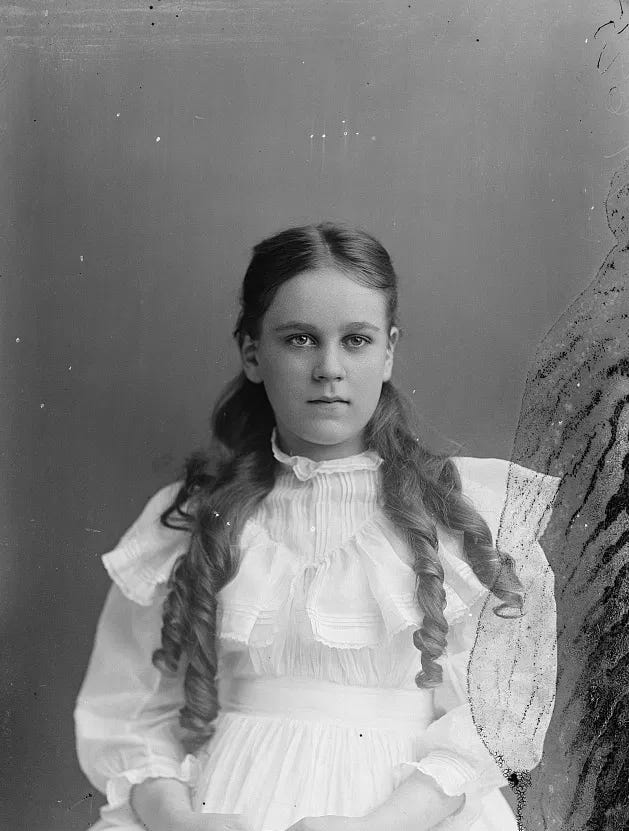
Breckinridge’s early life was both stunningly privileged and stultifyingly confined. All the moving and traveling left her feeling “unsettled,” Mary recalled, and she struggled with loneliness. While Breckinridge men went to college and assumed leadership roles, she was expected to get married, have children, and maintain the home. “I chafed at the complete lack of purpose,” she wrote. Inspired by the opportunities of the Progressive Era, she yearned to “do something useful” after graduating from high school, something that would add her name to the long line of Breckinridge leaders. But that’s not what a good Southern woman did.1
Her beloved elder cousin, Sophonisba “Nisba” Breckinridge, had somehow charted her own path. With her parents’ blessing, Nisba graduated from Wellesley College and embarked upon a pioneering career in law and academia, becoming the first woman to graduate from the University of Chicago Law School and helping launch the field of professional social work. Yet Mary’s parents saw “Nisba” as a bad example, a woman who “refused to go back home to live,” and they forbade Mary from attending college.2
Mary was torn between “the life I longed to live” and the “life allowed me.” She wanted marriage, a stable home, and a big family (with 8 kids!). But she also wanted adventure, a career, a purpose.3
Tradition initially triumphed. She married at age 23, but her husband died less than a year later. She then spent a summer at a girls’ school in North Carolina, where she watched a student die of typhoid. That experience drove her to pursue nursing. After graduating from nursing school, she returned home to Arkansas. She remarried in 1911 and gave birth to a son, Clifton Jr. (known as “Breckie”), whom she adored.
Tragedy soon derailed tradition. She gave birth to a second child, a daughter who lived only six hours, and soon thereafter adorable Breckie died of appendicitis at age four. Never happy in her marriage, a distraught Breckinridge filed for divorce in 1920 and re-assumed her maiden name, “which I did with a feeling not unlike that in which one puts on again an old pair of workday shoes,” she wrote.4
Widowed, grieving, and divorced, Breckinridge began her life anew. World War I had just ended, and she volunteered to help organize nurses for the American Committee for Devastated France. While overseas, she met British nurses who also served as midwives. Brilliant! We could use this in America, she thought, particularly in her native South where doctors were scarce and pregnant women relied on midwives who often lacked the latest medical knowledge.5
She returned home determined to establish a British-style nurse-midwife program in America. She went back to school to burnish her credentials, then traveled to the mountains of eastern Kentucky to survey midwives and mothers. Why Kentucky? She had family connections in the area — the Breckinridge name went a long way in the upper South — and she had the support of the state’s public health commissioner. She also knew that if her model worked in eastern Kentucky, it could work anywhere.6
By 1925, she was ready to launch her life’s work: the Frontier Nurse Service. From a central hospital based in Hyden, Kentucky (pop. 313), British nurse-midwives from FNS provided prenatal care, delivered babies, and taught families about hygiene and sanitation. “There was no motor road within sixty miles in any direction,” Breckinridge remembered, so the nurses made home visits on horseback, carrying saddlebags of medical supplies as they rode through the remote hollows of Appalachia. Their five-dollar fee was rarely paid in cash, but rather “in labor, in fodder for our horses, in pickled onions, quilted ‘knivers,’ skins of ‘varmits,’ and split-bottom chairs.”7
Neatly attired in gray-blue uniforms with riding breeches and boots, Breckinridge and her FNS nurse-midwives captured hearts nationwide. In the public mind, they were “angels on horseback,” an image that Breckinridge worked hard to cultivate and maintain.
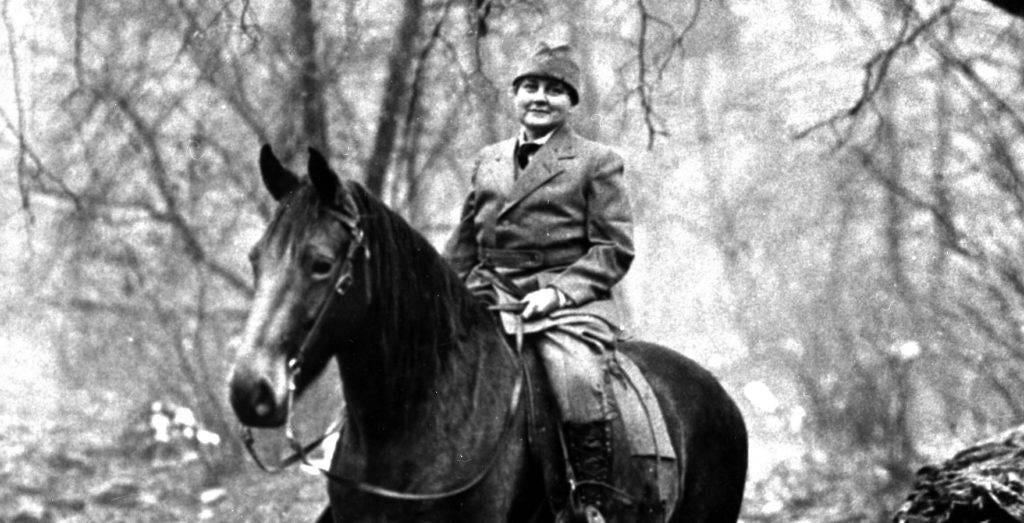
Well-connected and media-savvy, the square-jawed, blue-eyed Breckinridge was a fundraising dervish, a riveting speaker with a commanding presence despite her small stature. Critics questioned her smoking, her cursing, her imperious decision-making, her haircut, and everything else that was “unladylike” about her, but she did not heed them. Even after a wicked 1931 fall from a horse broke her back, she strapped on a brace and continued to captive audiences with heartwarming tales of adventurous nurses, brave mothers, and grateful children. “She touched consciences and loosened purse strings wherever she went,” wrote the Louisville Courier.8
The FNS began with babies, but soon expanded to address patients’ broader medical and economic needs. A 1932 report from the Metropolitan Life Insurance Company concluded that “If such service were available to the women of the country generally there would be a saving of 10,000 mothers’ lives a year in the United States.”9
In 1939, when World War II forced British nurse-midwives to return home, Breckinridge redoubled her efforts to train Americans in the field. She founded the Frontier Graduate School of Midwifery, which lives on today as Frontier Nursing University.
Breckinridge spent nearly four three decades at the helm of FNS. During her tenure, FNS had a phenomenal success rate – more than 14,500 babies delivered with a mere 11 maternal deaths. Her work showed that nurse-midwives could play a valuable and cost-effective role in meeting the needs of rural patients.10
When she died in 1965, mourners hailed her as a hero. “While the deeds of her famous ancestors live on in musty history books,” wrote the Hazard Herald, a Kentucky newspaper, “her deeds live on in whole generations of living people.” She had lived up to her storied name.11
And yet . . . Mary Breckinridge was racist. She did not hire Black midwives in the FNS, and she held stereotypically patronizing views of the Black people in her own life.
Is that surprising? She grew up in the post-Reconstruction South, a racially segregated world marked by disenfranchisement and lynching. Very few White Southerners could escape the pull of White supremacy. Even her progressive cousin Nisba had to leave the South to pursue her egalitarian ideals.
That may feel frustrating and disappointing. We want her to transcend the limitations of her time. In many ways, she did — she upended notions of Southern womanhood and established herself as a visionary leader in public health. Yet we struggle to reconcile the inspiring “angel on horseback” with the reality of the human being who actually lived. Her racism may seem like a deal-breaker, and we may be tempted to dismiss her as just another privileged racist who doesn’t deserve our accolades or appreciation.
But I would encourage us to appreciate Mary Breckinridge in her full humanity. She was a flawed, complicated figure. So are we all. She couldn’t possible live up to the angelic image that she strived to convey to the world, just as none of us can live up to the idealized version of ourselves that we may strive to uphold. Nonetheless, she lived a remarkable life that changed our country for the better.
Sources
Breckinridge, Mary. Wide Neighborhoods: The Story of the Frontier Nursing Service. University Press of Kentucky, 1981. (Original, 1952)
Crowe-Carraco, Carol. “Mary Breckinridge and the Frontier Nursing Service.” The Register of the Kentucky Historical Society, Vol. 76, No. 3 (July 1978): 179-191.
Dye, Nancy Schrom. “ Mary Breckenridge, the Frontier Nursing Service and the Introduction of Nurse-Midwifery in the United States.” Bulletin of the History of Medicine, Vo. 57, No. 4 (Winter 1983): 485-507.
Frontier Nursing University. “History of FNU.”
Goan, Melanie Beals. “Establishing Their Place in the Dynasty: Sophonisba and Mary Breckinridge’s Paths to Public Service.” The Register of the Kentucky Historical Society, Vol. 101, No. ½ (Winter/Spring 2003): 45-73.
Mary Breckinridge: The Frontier Nursing Service & Rural Health in Appalachia. UNC Press, 2008.
Pletsch, Pamela K. “Mary Breckinridge: A Pioneer Who Made Her Mark.” The American Journal of Nursing, Vol. 81, No. 12 (December 1981): 2188-2190.
Breckinridge, Wide Neighborhoods, 45.
Breckinridge, Wide Neighborhoods, 35.
Beals, Mary Breckinridge, 24.
Breckinridge, Wide Neighborhoods, 59.
Dye, “ Mary Breckenridge, the Frontier Nursing Service and the Introduction of Nurse-Midwifery in the United States,” 485.
Dye, “ Mary Breckenridge, the Frontier Nursing Service and the Introduction of Nurse-Midwifery in the United States,” 491; Crowe-Carraco, “Mary Breckinridge and the Frontier Nursing Service,” 180.
Dye, “ Mary Breckenridge, the Frontier Nursing Service and the Introduction of Nurse-Midwifery in the United States,” 492; Crowe-Carraco, “Mary Breckinridge and the Frontier Nursing Service,” 183.
Breckinridge, Wide Neighborhoods, xiii; Beals, Mary Breckinridge, 3.
Crowe-Carraco, “Mary Breckinridge and the Frontier Nursing Service,” 190.
Beals, Mary Breckinridge, 2; Dye, “ Mary Breckenridge, the Frontier Nursing Service and the Introduction of Nurse-Midwifery in the United States,” 485.
Beals, Mary Breckinridge, 1.
You’ve written character description which challenges me to reconsider some opinions I currently hold regarding certain living individuals. We certainly are complicated and none of us perfect. Thank you.
The year that MB fell from her horse, 1931, was the year that my New England mother volunteered to teach for a year in a one-room school in Pippa Passes, in the hollows of eastern KY. Mary Lee Hutchins, the daughter of a Boston surgeon, was a horse lover and recent graduate of Vassar College. She was inspired by stories of the Frontier Nursing Service. -Peter H. Wood